On the night of February 3,2026, the lights went down at Madison Square Garden. This was for the last act of the 150th Westminster Kennel Club Dog Show.
For traditionalists, it was a night of unparalleled history. For modern dog lovers like us at Dog with Blog, every street-side “mutt” and shelter rescue is beautiful. This moment makes us think about why the world’s top “beauty pageant” is changing so much in public opinion.
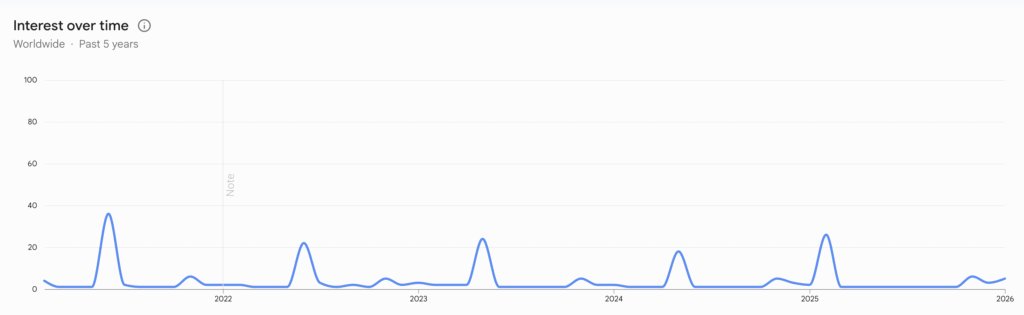
As the purple carpet was rolled up, the data told a story the judges didn’t: while the dogs were impeccable, the public’s search interest has plummeted by 40% since 2022. The “perfect” dog is no longer a status symbol; the “healthy, rescued” dog is.
Despite the milestone 150th anniversary, the “search paradox” we’ve been tracking since 2022 has reached a tipping point. Monthly search volume for Westminster usually sits at 100,000, but the February spike has seen a drastic decline. In 2022, search interest peaked at 2.4 million; by 2025, it had slipped to 1.5 million. Early data for February 2026 shows that the trend is still going. There is about a 40% drop in peak interest over the last four years.
Westminster 2026 Results
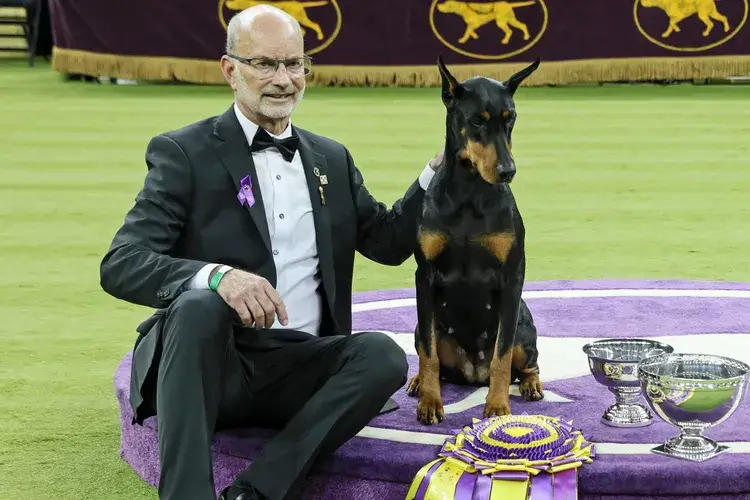
The task of picking the 150th winner fell to David Fitzpatrick, a man who knows exactly what it takes to stand in the center of that ring. From a sea of 2,500 entries, he narrowed the world’s best down to seven finalists before awarding the trophy to Penny, a Doberman Pinscher of undeniable presence. As part of the 150th-anniversary celebrations, seeing past legends like Siba and Wasabi back on the green carpet on Monday set a high bar. Penny didn’t just meet that bar; she cleared it, joining a century-and-a-half of history.” Penny’s reach and drive were unmatched as she maintained a perfect stack even as the flashbulbs went off, showing that ‘look at me’ attitude that Fitzpatrick clearly couldn’t ignore.
Seeing Andy Linton back in the center ring with a Doberman felt like a glitch in the matrix—in the best way possible. It’s been 37 years since he took the trophy with Indy (1989), and you could see the emotion on his face during the final go-round. This wasn’t just a win; it was a career-defining full circle.
The Garden was absolutely electric for Cota, the Chessie. When Judge David Fitzpatrick pointed to him for Reserve, the roar was deafening. It’s a bittersweet ‘always a bridesmaid’ moment for the Retriever fans who have been waiting 150 years for a Best in Show win, but Cota’s performance was undeniably world-class.
The televised clips of Penny during her victory lap showed a dog at the height of her “conformation.” However, this historic win could not hide the ongoing debate about the breed’s genetic health.
The final seven also included other remarkable breeds, each representing the pinnacle of their respective standards:
- The Afghan hound, Zaida, whose flowing coat and regal gait epitomized the hound group.
- JJ, the Lhasa apso, a non-sporting champion with deep roots in Tibetan history.
- The smooth fox terrier, Wager, handled by handler Andy Linton‘s colleagues in a spirited display of terrier tenacity.
- Graham, the Old English Sheepdog (Herding), and Cookie, the Maltese (Toy), rounded out a group that prioritized aesthetic perfection.
| Group | 2026 Winner | Breed |
| Best in Show | Penny | Doberman Pinscher |
| Reserve Best in Show | Cota | Chesapeake Bay retriever |
| Hound Group | Zaida | Afghan hound |
| Terrier Group | Wager | Smooth fox terrier |
| Non-Sporting Group | JJ | Lhasa apso |
| Toy Group | Cookie | Maltese |
| Herding Group | Graham | Old English Sheepdog |
Why Interest is “Going to the Dogs”
As the dust settles on the 150th Westminster Dog Show (2026), the numbers tell a story that the glitzy broadcast on Feb 3 ignored: search interest is dwindling by the year. While the handlers in their tuxedos still jog in circles, the world outside the ring has moved on. This isn’t because we love dogs less; pet ownership is actually up. Because the cultural cachet of the “purebred beauty pageant” is slipping. The dwindling interest isn’t just a “cord-cutting” issue—it’s a cultural divorce. Now, social media makes us focus on more relatable and diverse dog stories.
A main concern exists with events like Westminster. The focus on the “pure” breed often harms the dog’s health. Critics argue that dog shows centered on conformation are essentially rewarding genetic “flanderization.”
1. The “Aesthetic vs. Animal” Conflict
In 2026, we have more data than ever on canine health, and it’s making the “Breed Standard” look like a blueprint for suffering. When we see a Terrier Group winner or a flat-faced Bulldog struggling to regulate its temperature under the arena lights, it no longer looks like “excellence.” It looks like a design flaw.
- The Science: Geneticists are increasingly vocal about the “bottleneck effect” in purebred registries.
- The Shift: Modern dog owners prioritize “healthspan” over “hand-stacking.” A dog that can hike five miles is now more prestigious than one that can stand still for five minutes.
2. The Rise of “Rescue Prestige”
The dog show world was built on the Victorian idea of “purity” as a status symbol. But in 2026, the status symbol has flipped.
- The New Elite: On social media, the “hero narrative” of a difficult rescue—the three-legged mutt or the street dog from an overseas shelter—carries far more social capital than a purchased pedigree.
- The Advocacy Gap: Westminster remains an “exclusive” club in an “inclusive” era. By excluding the 80% of dogs that don’t fit a specific genetic mold, they’ve made themselves irrelevant to the average pet parent.
3. The “Uncanny Valley” of Professional Handling
Footage showing Penny or any Best in Show winner often feels “over-produced” to the modern viewer.
- Lack of Authenticity: We live in the era of the “dogfluencer”; raw, chaotic, and relatable videos of dogs being dogs.
- The Rigid Ring: Watching a handler bait a dog with a piece of liver to keep its tail at a precise 45-degree angle feels sterile. People want to see the bond, not the choreography.
4. Cord-Cutting and the “Event” Fatigue
Traditionally, Westminster relied on a captive prime-time television audience. In 2026:
- Fragmented Attention: Younger audiences are watching 15-second agility clips on Instagram stories, not a three-hour linear broadcast of a judge feeling a dog’s ribcage.
- The Value Prop: If the show doesn’t provide education or adoptable dogs, it becomes just another “beauty pageant” in a world that has largely cancelled human beauty pageants for being outdated.
At Dog with Blog, we vehemently support the “Adopt Don’t Shop” movement because we see the fallout of these standards daily. For every champion like Penny, many purebreds end up in shelters. People often give them up because they see them as “defective.” Sometimes, owners are not ready for the care needed by a dog bred for shows instead of a home. Even the “highest” levels of society are moving toward rescue over pedigree.
The “closed stud book” system used by many kennel clubs limits genetic diversity. This leads to the “Show Mill” phenomenon. In this case, they prioritize profit and awards over the health and longevity of the dogs. In contrast, the “mutt” or the “All-American Dog” possesses a hybrid vigor that we believe makes them the true “Best in Show.”
2026 FAQ: The New Normal for Dog Lovers
Can mixed breeds compete at Westminster?
Only in the Masters Agility Championship and Obedience trials. The main conformation show remains strictly for purebreds. The Agility trials have become the most-watched part of the week. This shows that fans like athleticism more than looks.
Why did interest in dog shows decline in 2026?
A shift in values caused the 40% drop in search volume. Modern owners prioritize rescue advocacy and are increasingly skeptical of breeding practices that lead to health problems. Until the ring opens up to health over heritage and mutts over masters, it will continue to be a prestigious party for a shrinking guest list.
What should Westminster dog show do for an inclusive event?
To save the tradition of the dog show, Westminster needs to stop treating it like a museum but like a community. If they want to survive another 150 years, it needs to move past the “conformation” bubble and embrace the dogs that 99% of the world actually lives with. The show must pivot from Aesthetics to Action and Advocacy. Instead of judging a dog against a rigid breed standard written in the 1800s, let’s judge them on Fitness and Temperament.
Imagine if every televised “commercial break” featured a local NY rescue dog with a QR code on the screen for immediate adoption applications?
The 150th Westminster Dog Show was a vivid display of history, but it felt like a ghost of an era that is slowly fading. We celebrate the hard work of handlers and the beauty of dogs like the Afghan hound and the smooth fox terrier. However, we still think of the underdogs. The true “Best in Show” doesn’t need a professional handler or a 150-year-old pedigree. They are the dogs waiting in shelters right now. They don’t have a “standard” to meet, but they have endless love to give.