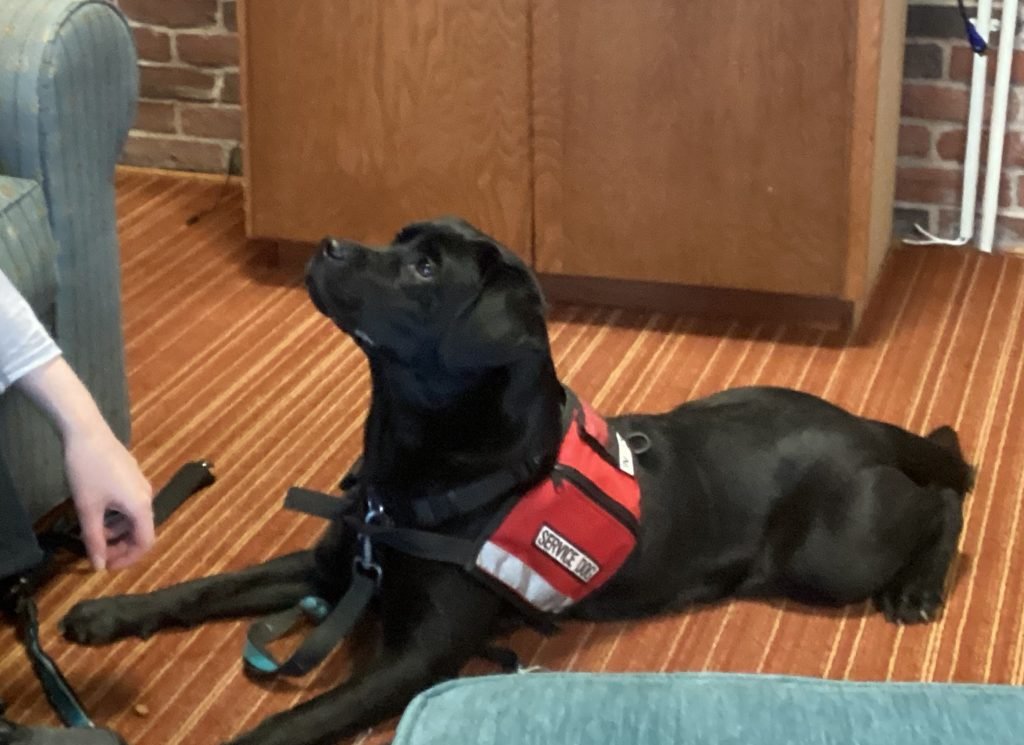
It’s back to school season, the dog days of autumn. Have you let your service dog training slide in the heat of the summer? Or has your training schedule fallen to the wayside due to symptom flares, vacation, or shuttling kids to camp? There is only one type of training that works: The training you do!
Building regular dog training habits into your schedule really helps your dog maintain consistent progress. While both dogs and people need a break sometimes, service dogs take a lot of work. As you recommit to training, we have 10 tricks that really work to help you fit training into your regular day.
Hang Your Training Kit by the Door
Do you intend to train when you take Dax out to potty or for her walk, but then you forget? Or you’re afraid if you go find the treats and pouch, she’ll have an accident? Keep your pouch with shelf-stable treats in a basket or on a hook by the door, with the leash. Put it back when you come in.

Find 5 Minutes in Your Day
Are there a few minutes in your schedule you find yourself playing mindless games on your phone or not doing much of anything? What if you spent a couple minutes working with your dog on one of your priority skills? Instead of doom scrolling between zoom meetings, spend a moment teaching Sirius the next steps of his task training, or practicing his DISC course homework. Dogs really benefit from short training sessions, so a few minutes is actually perfect!
Do you have five minutes…
- After you finish your morning coffee but before you need to leave for your commute?
- While you wait for your turn in the bathroom* as a family member or coworker takes too much time?
- In the afternoon lull between tasks?
- After dinner when you’re just hanging out?
Any moment you have free can be an opportunity to help your dog strengthen their skills!

Bonus Hack: Set a Timer for 2 Minutes
Don’t have 5 minutes? What about two? Take the pressure off. Set a timer on your phone for 2 minutes. Train until it goes off.
Service dog training in Bed and in the Bathroom
Beau doesn’t need you to stand in front of him with your hair combed. In fact, if you need him to task when you’re exhausted, sick, or depressed, he needs to know how to follow cues when you’re in bed, on the couch or recliner, or in the bathroom. So, train there! Keep sealed treat jars (and clickers, if you use them) by the toilet and in your nightstand. If you train for one minute every time you go to the bathroom, and before you fall asleep each night, that’s probably at least 10 minutes a day. Short sessions sprinkled throughout the day are perfect!

Bonus Hack: Remote feeder
If moving around or delivering treats is a challenge, put a couple of remote feeders around the house (such as the Treat & Train, Furbo, or others). Keep the remote control Velcroed to your wheelchair, cane, or cell phone. Mark with a “yes!” or “good!” when your dog does the right thing, then dispense. Even if you’re in a different room from the feeder, your dog will learn where the treats are dispensed and can keep coming back to you for another rep.
Train During the Commercials
Do you watch TV or listen to podcasts? Instead of watching or listening to the ads, turn the volume off for 3 minutes and ask Rigby for some skills! Can she hold her sit until the show comes back on? How many leave-its can she do during that allergy medicine commercial? Can you do a lap around the room with Rigby walking in position, then get back to the couch in time to see what happens next? If you’re using an ad-free streaming service, what about doing some service dog training before you let the next episode play, while the credits roll, or while the theme song plays? You don’t have to pass up your TV or podcast time to train, but incorporating one into the other can help get your dog the practice they need as well as letting you have the relaxation time you need.
Plan Something for You After Your Training Session
We spend so much time talking about positive reinforcement for your dog. Rewarded behavior is repeated behavior. But are you rewarding yourself for training Ivan? What is your favorite thing that you do in your day? Can you do a few minutes of service dog training before you do that? Schedule something nice for yourself for after your training sessions. It’s OK if that still involves your dog! If you really love playing with your pup, that could be your reinforcer just as much as it can be his. It could also be a special treat jar for you that you visit after working with Ivan, a calming or fun activity you enjoy, playing your favorite song, or having a mini dance party! What reinforces you? Use that to your benefit and give yourself something to look forward to after your sessions.
Get a Buddy
Telling someone else what we plan to do makes us more likely to carry out our intentions. It’s most effective if your plans are specific and concrete: “At 10:30, I am going to Bodhi for 5 minutes on Nudge, focusing on reinforcing a second nudge half the time.”
“Body doubling” (sometimes called coworking) with another owner-trainer can really help get you going! You can text them every morning with the times and behaviors you plan to train that day, then report on how it went at bedtime, OR simply text right before you train, and then after to tell them how it went. Because your buddy will do the same, you’re helping them and their dog, too. It’s a win-win-win!
If you have a friend who is also training their dog, ask them to be your training buddy. If not, no worries! We have a private Facebook group for anyone who takes our online classes or lessons. Clients use our group to share service dog training wins, ask questions, and post training videos. It’s also a way to connect with community. If you’re not a client, any social media can work; just post a training buddy request wherever people know you.
Bonus Hack: Coaching via Shared Training Log
You can combine body doubling and logging (see below) by working with a trainer who offers online check-ins via a shared training log — daily, biweekly, or weekly. We provide clients with a specialized training log on Google Sheets (such as this one for training a duration down-stay). You track your daily progress in the log. We look at the log on the agreed-upon days of the week and write recommendations for next steps, or kudos and encouragement!
Treat Jars Everywhere (or Make the Pouch an Accessory)
Is getting Lucy’s treats together the biggest impediment in your path? There are two options for how you can make sure to always have a treat on hand.
1. Put on the treat pouch every morning
Make the bait bag an essential part of your wardrobe, like your glasses or belt. Put it on when you get up. Take it off when you get into bed at night. BONUS: Does Lucy get super excited and know it’s training time whenever you put on the pouch? Wearing it all the time will desensitize her to the pouch as a cue, meaning she will eventually be calmer during service dog training, and she’ll have to pay attention to you all the time, not just when she sees the pouch come out. To help smooth the path to that time, wear a new pouch with no treats in it at first. Once that’s boring, put very un-exciting “treats” in it (that you won’t actually give her), such as uncooked pasta or lettuce. Eventually, you can start to put in the lowest-value food she’ll take, such as pieces of string bean or carrot, then her kibble, etc.

2. Strategic (out-of-reach for dogs) treat jars
Do you spend a lot of time on your couch or recliner? Put a tightly sealed treat jar in the cup holder or end table.
Bonus Hack: Bear-Proof Containers Velcroed to the Wall
Are you shaking your head in frustration because you know that Lucy will bust into or steal any treat jar she could possibly reach? Hang a nail or basket on the wall above the chair where she can’t reach. Or, to really get security, buy a bear-proof container from a camping supply store and use industrial-strength Velcro to affix it to the wall well out-of-reach.
You need treat jars in these locations:
- By the door, where you and guests enter (or leave)
- In your car (for the ride OR when you arrive somewhere OR when you get home)
- In the bathroom (as previously noted!)
- In your nightstand
- On your desk

Take a Class (like a pro trainer)
Here’s a little “inside baseball” secret about professional dog trainers: most of us take a lot of classes — both online and in person — to train things we already know how to train. Not only that, we often take our dogs through classes that teach behaviors our dogs already know, too. Why? Because otherwise we might not train our own dogs at all!
To get where we are, we first spent many years obsessively training our dogs to an extremely high level. Then we’ve spent years (or decades!), training other people’s dogs. The thrill has worn off, but our dogs still need training! A class helps because it…
- has a set time every week when we are scheduled only to train our dog
- has homework (which we keep up with, in part because of social pressure)
- has specific goals that gives us something concrete to shoot for
- has other students and trainers whom we feel some commitment to training around
If you’re having trouble motivating to train, register for a well-run rewards-based class. Even if Bailey already knows many of the skills, you’ll be able to move him further along — build more duration, train it with more distance or distraction. And we always learn new things from new trainers, too! If you’re looking for a service-dog specific online class with plenty of individual attention and coaching, check out our PEARL DISC class or Deep Pressure Therapy class.
Take a Handful of Food from Your Dog’s Normal Meal
You were going to feed Maisie anyway, so you might as well just grab a handful of her food and put her through her paces! Since meal times can be such a concrete, immovable part of the daily schedule, using that time as a moment of service dog training can ensure that your pup is getting her practice in, even on days where you really don’t have 5 minutes to spare. You don’t even need to break out the treats, since you’ve got the food in front of you already! Before you put the bowl down, train a few reps using bits of the food (a piece of kibble, or a spoonful of wet food) as your reinforcers. If you’re really struggling to fit training into your daily schedule, this is a great way to utilize routines you already have for your, and your dog’s, benefit.
Logs and Apps
Sometimes, the longer you’ve been training your service dog, the harder it becomes to choose what to train. You get overwhelmed, and put off training. We strongly recommend keeping a training log throughout your training journey! They have several advantages:
- If you ever face an access challenge, your log will document your dog’s training hours.
- Logs help you spot patterns; when your dog plateaus or backslides, the log will help you pinpoint why.
- Logs show progress. Because of brain negativity bias, we often forget how much progress our dog has made, focusing instead on what is hard now. Because a log shows reality, it provides essential encouragement.
- The longer and more skills you train, the harder it is to keep track of cues, criteria, and other details. A log helps you pick up where you left off.
We recommend a general training log (like this) to help you stay on top of daily training, and individual logs for each of the behaviors you’re training on to track specific progress with each skill (such as this one for down-stay).
If you already use a habit-tracking app, you can add training to it.

Try it! Let us know how it goes!
Have you tried any of these tips before? How did it go for you? What are your favorite ways to fit dog training into your day? Let us know in the comments!